
Category Archives for Blog

[Flash] You Don’t Have to Believe… Just Don’t Disbelieve
|
Still navigating pain in my rotator cuff from a fray last year, I decided to try acupuncture.
As my new acupuncturist started inserting needles into my shoulder, I flippantly joked, “It’s a little like hocus pocus, isn’t it? I have to really believe these needles will work.” She looked at me piercingly, “I don’t need you to believe. I need you not to disbelieve. Just suspend your disbelief and be open to what might happen.” With needles standing in formation across my upper back, I couldn’t do anything but reflect on her words of wisdom. How might all of our interactions benefit from a suspension of disbelief?
What’s the difference? It takes a concerted effort to disbelieve, dislike, disrespect, and disagree. When we intentionally halt our disbelieving, disliking, disrespecting, and disagreeing actions, we stop judging and even sabotaging an interaction, a relationship or a process. In the vacuum left by judgment, possibility thrives. The possibility that we might believe, like, respect, and agree. The possibility that we might connect, learn, grow, and thrive. The possibility of being surprised and delighted! Suspending disbelief is undoubtedly an act of courage, for we must step into the unknown determined to be curious – curious to know someone, curious to discover another perspective, curious to experience the world differently, curious to learn something new. To suspend disbelief…
It is cognitively discordant to be curious and judgmental simultaneously, making curiosity the cure for the common conclusion. © 2025. Ann Tardy and MentorLead. www.mentorlead.com. All Rights Reserved. |
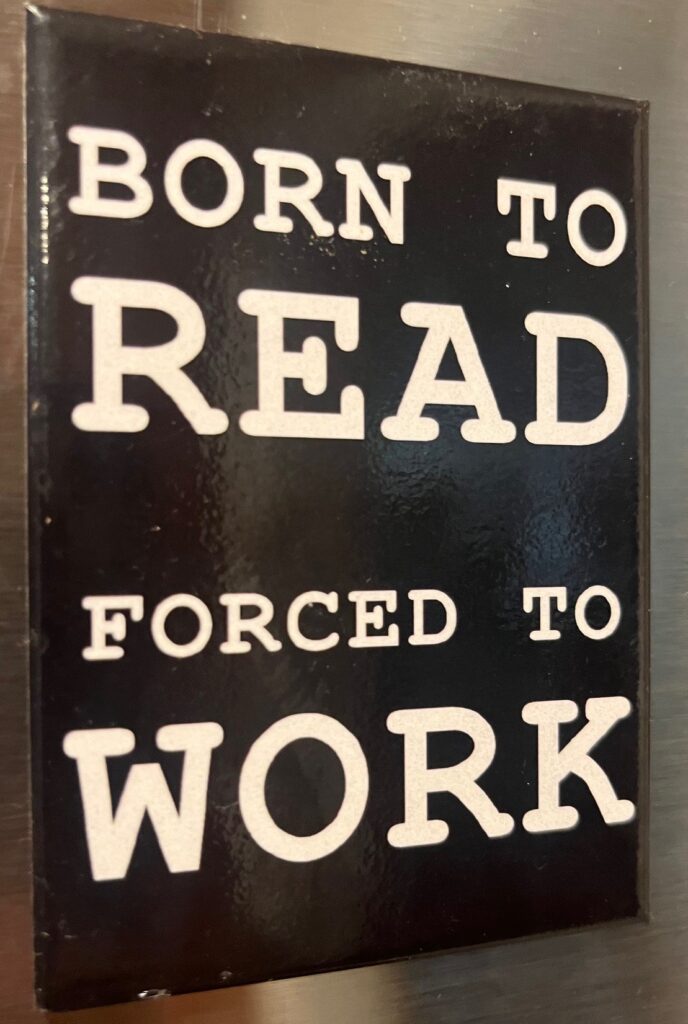
[Flash] Born to Read. Forced to Work (Strand Bookstore, NYC)
| As a child, I used to answer the what-do-you-want-to-be-someday question with, “Librarian” (I thought they just read all day!) And as an uncool teenager, I devoured books, seeking refuge in their pages. Today, I read seeking wisdom, divergent perspectives, and soul-fueling entertainment.
As we embark on a break this holiday weekend, I’m sharing a few of my favorite books – fiction, non-fiction, and memoirs! When you want to be a better Mentor, leader, and human being:
When you need a kick in the pants and a kiss on the cheek:
When you want mentoring via a memoir:
When you want heartfelt entertainment:
When you want to challenge your perspective:
When you want to be inspired by irrepressible women:
“So many books. So little time.” ~ Frank Zappa © 2025. Ann Tardy and MentorLead. www.mentorlead.com. All Rights Reserved. |

[Flash] Hope Outshines Happiness in Mentoring and Well-Being
|
In Season 3 of the hit television sitcom Schitt’s Creek, Johnny Rose suggests that hotel proprietor Stevie Budd inform guests that they will be gone for the afternoon.
Stevie finds a “Back in 15 minutes” sign for the front desk. The show’s writers were on to something! A recent groundbreaking study from the University of Missouri illuminates the deeper impact of hope. Psychology has long held that hope is tied to goal setting and achieving. But the Missouri researchers discovered that hope is more profound than merely the desire to accomplish a goal. It’s a “a vital emotional experience.” The study declared: “Hope is more essential to our well-being than happiness or gratitude.” Why? Because hope makes life feel meaningful. And experiencing life as meaningful is crucial for our emotional, mental, and physical health. Hope begins with the belief that our situation will improve at work, at home, and in life. That belief then compels us to invest time, energy, and patience in the possibility of a better outcome. That meaningful pursuit of a better outcome drives us to connect and engage, placing hope at the heart of mentoring:
Between 2005 and 2008, The Gallup Organization conducted a survey examining the four expectations employees hold for their leaders: trust, compassion, stability, and hope. About hope, Gallup discovered that we look to our leaders for inspiration for a better future. Essentially, we contribute value with our work, hoping our efforts will improve the future – ours, the team’s, and the organization’s. We want our work to matter. Based on the Missouri research, this hope that our work matters gives our work meaning and promotes our well-being. The Missouri researchers concluded that to enhance our quality of life, we must strive daily to boost our hope. Hope Boosters:
As Lue on our team often invites: “What’s the best that can happen?” |

[Flash] 82% Believe Bots Are Better Than Bosses — Here’s How to Reinvent Your Manager Role
|
According to the AI at Work Study conducted by Oracle and Future Workplace…
82% believe robots (aka AI) are better than managers at:
Uh-oh! What is left for managers to do if their people are turning to robots to solve problems? drumroll… Mentor people into future managers. The AI at Work Study asked, “What can managers do better than robots?” People reported:
Bingo! People want their managers to develop them – teach, train, prepare, guide, support, advise, listen, empower, grow, and help them thrive in their roles! When I started my business two decades ago, I didn’t know how to lead people, so I focused on finding and fixing issues! But I struggled to grow the business. My success shifted as soon as I evolved from a Problem Solver to a Developer of Problem Solvers. I was managing messes. I needed to mentor people. Today, I measure my mentoring when:
My team doesn’t ask permission to solve something – they ask to collaborate. They ask for my mentoring. How did I make this shift? By learning to:
Research conducted by Professor Paul Zak of Claremont Graduate University identified “challenge stress” as one of the eight leadership behaviors we can deploy to foster trust in our teams. It’s also a stealthy strategy for mentoring future managers. Challenge stress is the energizing pressure people feel when empowered with a growth opportunity. The brain eagerly looks for a solution to help them meet the challenge. Examples:
Challenge stress develops confidence, improves problem-solving skills, and deepens mutual trust. Knowing people flourish in the trusting, empowering environments we create, it feels silly to resist technology or attempt to out-problem-solve a robot. We can use this interesting time in history to reinvent the value we bring to people and organizations. Mentor the future. © 2025. Ann Tardy and MentorLead. www.mentorlead.com. All Rights Reserved. |

[Flash] Idea Advocates Mentor Lightly (just ask Bobbi Brown, Evite CEO, and Julie)
|
Bobbi Brown was working as a professional makeup artist in 1990 when she decided to create a lipstick.
In her words, she had “no clue, no experience, and no role models.” She had initiative. When Bobbi told her friend about her project, she said, “Can I write about it?” She was the beauty editor of Glamour magazine. Bobbi credits that article for the launch of her business. In 1995, Bobbi sold Bobbi Brown Cosmetics to Estée Lauer. Josh Silverman Upon learning about ToGather from Josh, one of his friends mentioned a company that was starting something called “Evite” which sounded similar. So, Josh reached out to their founders, and they decided to join forces. Josh became CEO of Evite, and they sold the company in 2001. Julie Cole Nine months later, Julie sent me an email highlighting her career, expressing a passion for mentoring, and expressing an interest in exploring any opportunities at MentorLead. I replied enthusiastically within five minutes, and Julie joined MentorLead in January. Julie recalls the courage it took to send me that email. But had she not communicated her aspiration, we would have missed the opportunity to work together! Idea Advocates Idea Advocates shepherd our ideas into the world.
Then, when Idea Advocates know, hear, meet, or discover someone or something that will make a difference, they proudly bring us that connection, solution, or opportunity. So, what stops us from announcing plans, passions, and pipe dreams to recruit Idea Advocates?
But to enroll Idea Advocates, we must:
Idea Advocates mentor sporadically, in spurts and with light touches. But only if we stop hoarding ideas and give people a chance to contribute. © 2025. Ann Tardy and MentorLead. www.mentorlead.com. All Rights Reserved. |

[Flash] Trading Truths – The Power of Mentors to Forge Deep Connections
|
Underpinning most mentoring relationships is the expectation that Mentees will “drive the relationship” – the goals, the direction, the cadence, and even the enthusiasm.
But without a meaningful connection, Mentees can be reticent to start that drive. Mentors, though, can forge the connection through the practice of sharing stories and trading truths. In the 1970s, psychologist Sidney Jourard introduced the “Self-Disclosure Theory” claiming that disclosure in relationships fosters trust, openness, and an enthusiasm to grow. He theorized that self-disclosure tends to be reciprocal (“Reciprocal Disclosure”) and a key component of building rapport and closeness. According to Jourard, even strangers tend to match each other’s level of disclosure.
Researchers Nancy Collins and Lawrence Miller concluded that people who disclose more are liked more and tend to like those they disclose to. That makes sense – it would be cognitively dissonant to disclose something personal to someone we didn’t like. Understandably, in our cancel culture, we’ve become hesitant to share, building walls instead of windows, and guarding ourselves from judgment, criticism, and other personal attacks. Feeling vulnerable can be unnerving. Dr. Douglas T. Kenrick implores, “Before we are willing to connect and accept someone into our world, we need to disclose important things about ourselves.” The courage to reveal and risk rejection signals trust in the other person – “I trust you to trust me.” To ensure a meaningful connection, Mentors must lead the way, initiating with self-disclosure. What to share?
Going first compels Mentees to meet openness with openness. Reciprocal Disclosure creates the safe space that is the bedrock of mentoring, promising confidentiality and psychological safety. When Mentees reciprocate with a personal disclosure, Mentors can:
When the walls come down, the sun shines on everyone. Being open to a genuine connection reinforces the foundation of trust. People are starved for connection. They seek mentorship not to hide and protect themselves but to connect, learn, and grow together. Mentors, we just need to go first. Mentees will follow our lead. © 2025. Ann Tardy and MentorLead. www.mentorlead.com. All Rights Reserved. |
[Flash] Are Human Mentors Obsolete in the Age of ChatGPT? (Spoiler: No!)
|
Artificial intelligence (AI) is hard to ignore – it’s dominating the conversation and changing how we engage on various levels.
Last week, I delivered my manager-to-leader program to an in-person audience of eager and engaged emerging leaders. When it ended, one of the participants, Sally, approached me for some advice about public speaking. Sally asked if I ever felt nervous on stage. I shared, “Of course! I always get nervous initially – that’s how I know I care. But I’ve learned to tell stories to shift my focus from my angst to my audience.” Feeling validated, Sally revealed, “When I get nervous, I ask ChatGPT to help me overcome my imposter syndrome. And it reminds me that I am better than I think.” I felt punched. She turns to ChatGPT for mentoring?! Are human mentors obsolete now? (ChatGPT is simply a version of AI that generates human-like conversational responses to questions. Instead of spending hours weeding through websites and navigating a slew of derailing clickbait when we need information, ChatGPT filters the internet for us and produces answers in seconds!) I decided to ask the culprit. I typed the following into the prompt box in ChatGPT, “What advantages does a human mentor have over ChatGPT?” Here’s a summary of the results it generated for me:
Now, I felt validated! Sally didn’t ask ChatGPT about my experience, advice, and insights – she asked me personally. And Sally could have asked ChatGPT for information about managing vs. leading, but she opted instead to attend an in-person program to connect with and learn from others. While ChatGPT is indescribably efficient, providing us valuable information and even advice, it is a poor substitute for mentoring with a human.
Its sole job is to produce intelligence, not help us gain wisdom – that’s what Mentors do. “We learn when we deeply process information. If we’re removed from that and we’re delegating everything to ChatGPT, we’re not connecting to that information.” ~ Gloria Mark, Professor of Information Sciences © 2025. Ann Tardy and MentorLead. www.mentorlead.com. All Rights Reserved. |

[Flash] Turning Failure Into Fuel (When Adam Grant Became a Real Person)
From failure celebrations to failure awards, there has recently been a noticeable and concerted effort to de-stigmatize defeat.
Why? Because innovation suffers when people become too afraid to take risks.
On a recent episode of his podcast Work Life, Wharton professor Adam Grant tackles this topic by interviewing U.S. Army Lieutenant Colonel Chaveso “Chevy” Cook.
Chevy is known for sharing a “failure resume” with his new boss and his peers.
Along with his accomplishments, he lists in this resume his defeats: schools that rejected him, awards he didn’t receive, opportunities he missed, and leadership disappointments.
Why the confessional? Integrity. In his words, he wants people to know him as a whole person. “I think it keeps me humble.”
The result? Immediate connection and trust. Chevy reported that his failure-sharing creates a safe space, prompting others to share their own moments of failure.
Inspired by this exercise, Adam revealed his own lowlights during the episode:
- failed to make the basketball team in school,
- cut from the soccer team,
- failed the basic writing test in college,
- failed to finish his four years as an NCAA diver,
- rejected by University of Virginia for his first teaching job,
- turned down for a TED Talk three times
While I felt immediate relief that Adam Grant, a seemingly effortless success, is in fact a real person who has missed like the rest of us, I couldn’t help but wonder…
Why are we sharing failures and not resilience?
I’m far more interested in what Chevy and Adam did after each of their fails.
- How did they respond?
- What did they learn?
- What insights did they have?
- Did they pivot or persevere?
Too much failure bragging, and we lose the value of flops: the learning!
As a Mentor, sharing a failure resume is an easy way to decrease the intimidation Mentees often feel. Revealing our stumbles can de-risk the interaction while kindling trust and connection.
But that’s just the start. The point of mentoring is to learn from and contribute to each other, and we do that by studying those stumbles.
Exploring the what-did-you-do-next after a disappointment turns failures into fuel:
- What did you learn from that experience?
- What helped you bounce back?
- Did you pivot your goals or persevere?
- How did this failure inform future decisions?
- What will you do differently next time?
Resilience is forged in cuts, while wisdom is etched in scars.
© 2025. Ann Tardy and MentorLead. www.mentorlead.com. All Rights Reserved.