
All posts by Ann Tardy
[Flash] Unmasking Mentees – The Invisible Power to Grow as You Go
|
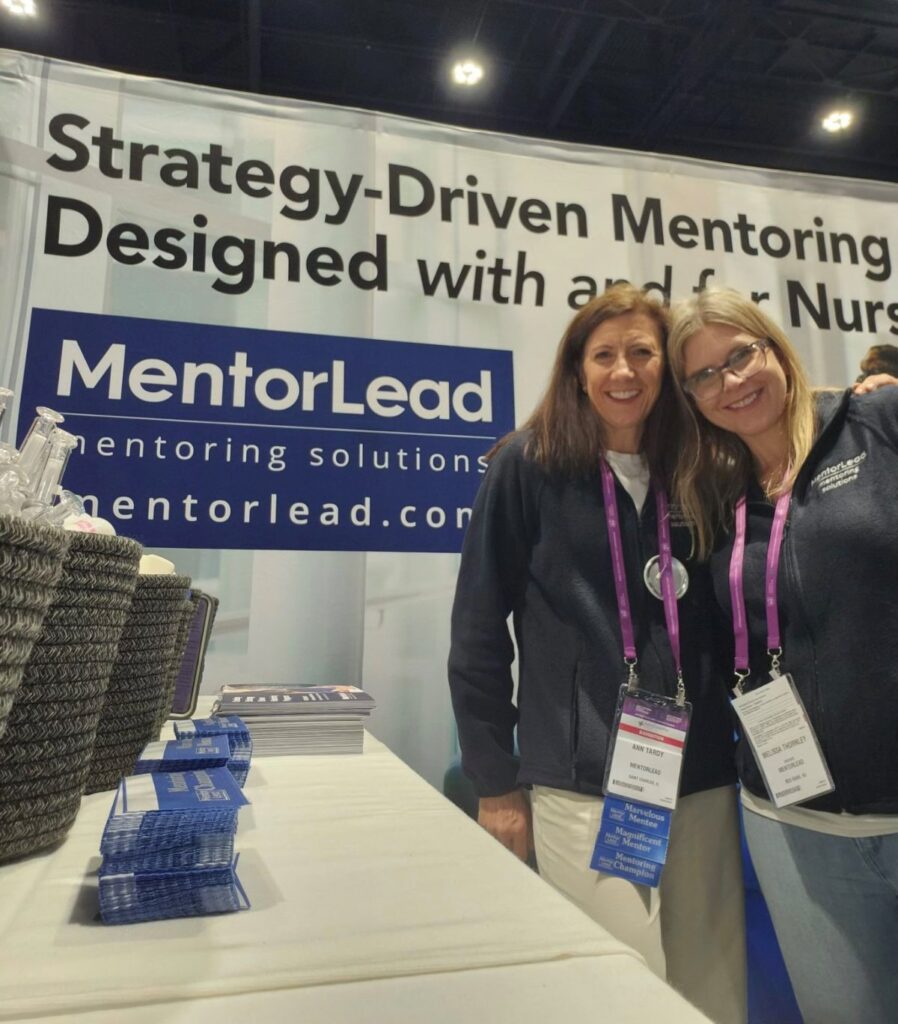
Last week, we had the pleasure of exhibiting at the ANCC Magnet Conference in Chicago, a celebration of best-in-class hospitals and the nurses who contributed to the designation.
At our booth, we attracted bedside nurses to nurse leaders with our “spin-it-to-win-it!” carnival game – everyone won a prize! After they won, we offered them a gift – a mentoring ribbon to attach to their conference lanyard. We had three different ribbons, and to help them choose, we eagerly inquired, “Are you a Mentee, a Mentor, or a Mentoring Champion?” Suddenly, the delight of winning a prize was replaced with bewilderment. The attendees stared, searching for an answer. Eventually, they concluded, “I guess I’m a Mentor…” or “Sure, I’ll be a Mentoring Champion.” But no one exclaimed, “I’m a Mentee!” In fact, of the 900 ribbons we brought to the conference, we left with:
Dropped into an unexpected social experiment, I paused to consider what happened:
And just like that, I realized that my experiment was flawed. I assumed that everyone knew the why and what of being a Mentee! Had we framed the interaction better, attendees would have been enthusiastically grabbing for the Mentee ribbons! Using different questions, we could have educated people on the concept and decreased the apprehension, even amid a bustling conference exhibit hall!
If we had taught attendees that a Mentee mindset is a learner mindset, a growth mindset, I’m confident we would have run out of “Mentee” ribbons! Ironically, being a Mentee is about learning through our connections – precisely the benefit of attending a live conference! In the future, with better questions and richer conversations, I know attendees will confidently effuse, “Yes! Yes! Yes! I’m a Mentee, a Mentor, and a Mentoring Champion!” Ultimately, aren’t we all? © 2023. Ann Tardy and MentorLead. www.mentorlead.com. All Rights Reserved. |

[Flash] How Starbucks CEO Leveraged Reverse Mentoring to Plunge into His New Job
|
When Laxman Narasimhan accepted the job of Starbucks CEO last year, he didn’t drive to the corporate office. Instead, he donned a green barista and started working in a Starbucks café.
Before taking the reins from founder Howard Schultz, Laxman spent six months immersed in Starbucks cafés worldwide. During this time, he became a trained barista, learning to make favorite drinks while architecting a vision for the company’s future. “This immersion experience informed my leadership role,” says Laxman. Why did the new CEO plunge into coffee making before poring over the company’s financials? To understand the culture from the lens of the employees (called “Partners”). Laxman set out to discover first what it means to be a Starbucks Partner by experiencing it. Through this adventure, Laxman allowed himself to see the business through their eyes. He witnessed what he calls our “crisis in loneliness” and discovered, with input from Partners, Starbucks’ unique opportunity to address it. Together, they contemporized the company’s mission: “With every cup, with every conversation, with every community – we nurture the limitless possibility of human connection.” Laxman’s impactful stint as a barista was Reverse Mentoring – he was mentored by people who essentially work for him. Reverse mentoring occurs when a less tenured or experienced person mentors a more tenured or experienced person. For example, a Vice President chooses a recent graduate new hire to mentor her as she improves her social media strategies. However, the most significant barrier to Reverse Mentoring is ego – the more miles under our feet, the less we think we need to learn, especially from anyone junior in age or experience. But we can mitigate ego by focusing on the potential of Reverse Mentoring. Giving people the opportunity to lead their leaders works to:
Relentlessly curious, Laxman reflected in a recent interview, “The more I learn, the more I realize how much I don’t know.” Lucky for Laxman, he’s got thousands of potential Mentors! © 2023. Ann Tardy and MentorLead. www.mentorlead.com. All Rights Reserved. |

[Flash] Deploying Battle Buddies to Cultivate Fortitude and Community
|
Faced with an increase in suicides, the US Army turned to a tried-and-true solution: human connection.
In 2000, the US Army started assigning every recruit in Basic Training a Battle Buddy to tackle high anxiety, stress, and fear. Through this forced partnership, soldiers:
When the COVID-19 pandemic hit, the University of Minnesota Medical Center (UMMC) faced a similar urgency to address its staff’s acute mental health needs. Due to the high anxiety, stress, and fear experienced by its healthcare workers, UMMC sought a solution that it could deploy rapidly with high scalability, low cost, and few resources. Like the Army, UMMC turned to human connection and adapted the Battle Buddy system:
To guide their daily check-in conversations, each Battle Buddy received a pocket-card with thoughtful, compassionate questions:
By intervening with an in-the-moment-of-crisis solution, UMMC demonstrated its commitment to cultivating a working environment where people felt supported, validated, and ultimately resilient. In its 2020 paper entitled “Battle Buddies: Rapid Deployment of a Psychological Resilience Intervention for Healthcare Workers During the Coronavirus Disease 2019 Pandemic,” UMMC stated: “Given the remarkable adaptability of human beings, we believe that, by promoting resilience, our diverse health care workforce can emerge from this monumental challenge with new skills, closer relationships, and greater confidence in the power of community.” People face proverbial battlefields daily, not just in combat or during a pandemic. While human connection is essential, it often needs to be intentionally constructed. Where could you deploy a Battle Buddy model on your team or in your organization? © 2023. Ann Tardy and MentorLead. www.mentorlead.com. All Rights Reserved. |

[Flash] Unlock Lessons from Sorority Pledging to Strengthen New Hire Experiences
|
Desperate to shrink the enormous college campus, I joined a sorority as a freshman.
All new pledges in the sorority chapter received a “big sister.” I remember when my big sister chose me, I felt like I belonged! Lisa became my confidante and champion as I transitioned from pledge to sorority sister that first year. Likewise, every junior in the chapter was expected to serve as a big sister. Why? Because the sustainability of the chapter relied on new pledges becoming sorority sisters and paying monthly dues. The big sister/big brother model is an evidence-based strategy to improve onboarding and retention. For the past decade, a research organization, Phired Up, collected and analyzed data to determine why members leave fraternal organizations. They identified 3 main reasons: (1) Misaligned Expectations. (2) Lack of Connection. (3) Discord. In their report, Phired Up recommends sororities and fraternities take the following actions to create engagement:
In summary, to retain chapter members, deploy “Bigs” to mentor, engage, and help new pledges find success as college students. Why should we care about this report on sororities and fraternities? Onboarding new members to a team or new nurses to a hospital is no different. Simply put:
Here’s where it gets nuanced. Most organizations already have some sort of onboarding initiative or residency program. So, where do many go wrong? They either lack mentoring or…
As a sorority pledge, I would not have created a relationship with a big sister (a mentor) if someone had told me that it was optional or my job to establish. Why? I felt intimidated, insecure, and isolated as a newbie. Asking an established chapter member to mentor me would have felt overwhelming and vulnerable. New hires often feel the same way. So what to do?
If everyone in your organization takes someone under their wing, your organization’s culture will inevitably shift. Retention doesn’t happen – it’s engineered through engagement. And mentorship is the spark. © 2023. Ann Tardy and MentorLead. www.mentorlead.com. All Rights Reserved. |

[Flash] Change Your Environment. Change Your Life.
|
When I wanted to write my first book, I heard an author share this advice: “Live in one place. Work in another place. Write in your third place.”
At the time, I was living in San Francisco in an indescribably small condo, working remotely in a corner of my kitchen. I needed a third place. I discovered a Starbucks two blocks away that opened at 5:30 a.m. It became my third place for three months while I wrote my book each morning. It worked! While I’ve always credited my willpower for my success and blamed it for my stumbles, that “third place” mattered. According to the book Willpower Doesn’t Work by Benjamin Hardy, success has more to do with changing our environment than changing our willpower. He says: “Your environment influences you whether you realize it or not.” “Continuing to focus on mindset, willpower, and goal setting is an outdated and misplaced approach to success. It’s not that these strategies are inherently bad. Rather, it’s that the focus is entirely wrong.” “The future of self-help will not be focused on ‘the self,’ but rather it will be focused on the environment that shapes the self.” While Hardy primarily speaks to how we design the physicality of our environment, I read the book in reference to the people we choose to spend time with – they either contribute to or contaminate our environment. As I pored over his book, I reflected on our mentoring programs. I constantly implore participants to “Make time for mentoring!” But isn’t this merely a shrouded appeal to mindset and willpower? Instead, I should ask them if they want to change their lives. When you want to change your behaviors, your success, and your life, change the people in your environment:
The people you surround yourself with are a gateway to your future… choose intentionally! © 2023. Ann Tardy and MentorLead. www.mentorlead.com. All Rights Reserved. |
[Flash] Unleashing Freedom: How My Dog Taught Me the Power of Choices
|
My dog ran away.
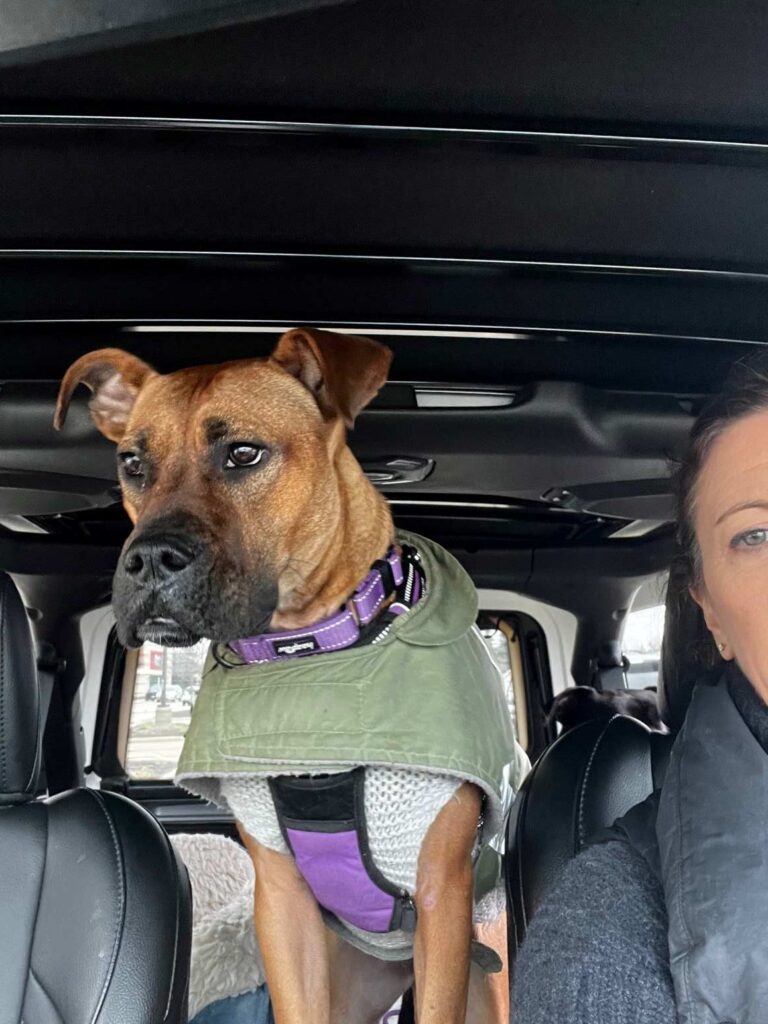
In April, we adopted Ollie, a vigilant but fearless 2-year-old boxer mix who had been abandoned. The rescue organization warned us that she was a “runner,” but we had no idea… After a car ride one afternoon, we opened the door to let her out. But something spooked her. Before we could grab her leash, she took off, like a hostage tasting freedom. Instinctually, we ran after her, shouting her name and chasing Ollie through town until we lost her in a wooded area. We spent the next seven hours searching desperately. And each time we spotted her, she sprinted away – in her feral state, there was no catching her. Near midnight, I drove home to let my other dog out. And that’s when I found Ollie in the backyard – she came home! The next day, we purchased a GPS tracker for her harness and hired a trainer to train us. Upon hearing our saga, the trainer said compassionately, “You can’t chase Ollie. Coming to you needs to be Ollie’s choice. Not yours.” I hadn’t given her any choice! My mentoring program leaders similarly grapple with the choices they offer participants in their programs. With too much choice (“They’re adults; they’ll figure it out”), participants may flounder and relationships fizzle; with too little choice (“Let’s dictate every aspect of their relationship”), participants can feel hindered and disempowered. An underlying goal of any mentoring program is to teach people transferable mentoring skills. But that requires giving the participants some control over their experience and success – choices! Research demonstrates the upside of choice:
Most importantly, research reveals that these benefits occur regardless of whether the choice is actual, trivial, or illusory. Ollie tested this choice theory last weekend. In our backyard, she found a weak board in the wooden fence and pushed her way through it. This time, I didn’t panic, chase, or shout when I realized she had escaped. Instead, I offered in a sweet, sing-songy voice, “Hey, Ollie Girl! Wanna go for a ride in the car?” (One of her favorite activities.) She turned to me excitedly, ran back to our fence, followed me alongside it until we reached the driveway, and jumped into my car – her choice. Pursuit averted! People support that which they help choose. Apparently, dogs do, too! © 2023. Ann Tardy and MentorLead. www.mentorlead.com. All Rights Reserved. |

[Flash] One Question that Bridges Strangers into Friends
| John: Early in his career, John Stephens was working in the studio helping another artist record an album when one of the guys started calling John “Legend.” “I was initially hesitant to take it on as I didn’t have a record deal yet, so how could I call myself a ‘legend’? But then I decided to grab it because I’m not going to go into my career with this fear that it won’t work out. I’m going to go live up to this name. It was a bit audacious, I know.” Sigourney: “I had great trouble at the height of six feet, saying my name is “Sue” – so small. Then I read the book The Great Gatsby and saw the name “Sigourney,” I liked its look – it goes on for three syllables. I’m going to use it as a placeholder, I thought. It wasn’t supposed to be a stage name.” Bono: The Question It serves to unlock connections in a few ways:
In addition, this one question decreases the inevitable anxiety of meeting someone new because it shifts the spotlight from “We don’t know each other!” to “What could we learn about each other?” When you are eager to connect with a new person or strengthen the relationship with a colleague, a mentoring partner, or a friend, simply (but genuinely!) inquire about their name. Everyone has a story. Even no story is a story. © 2023. Ann Tardy and MentorLead. www.mentorlead.com. All Rights Reserved. |

[Flash] Success Stacking: Harness the Power of Post-Achievement Moments
| Harpist Holly Thaggard founded the SPF products company Supergoop! out of a personal mission to de-seasonalize the usage of sunscreen.
While growing her company, she navigated roadblocks, pivoted her strategy, and exhausted her life savings. Eventually, after demonstrating demand for her product and leveraging her network, Holly earned the attention of an executive at Sephora, the beauty retailer. Her trip to San Francisco to pitch her product to Sephora was a turning point. Holly recalls feeling great about her presentation and the potential for partnership. But as soon as she left Sephora and before heading to the airport, she called Nordstrom to request a meeting to pitch Supergoop!. Why? She shared the following in a recent interview on the Guy Raz podcast How I Built This… “My father had this theory about doing things in twos. He always said, ‘The best time to accomplish something is after you’ve accomplished something. You’re on a high. You feel optimistic. You feel good about yourself.’ Whenever I had done something well, he would say, ‘That’s awesome, Holly. Now, what are you going to do?’” Holly’s father was right – stacking successes works. When we accomplish something, our brain releases dopamine, the brain’s feel-good neurotransmitter. And because feeling good is addictive, we are seduced to repeat the associated behavior (accomplish something!) in order to feel good again. Even simple to-do lists generate great satisfaction because checking off small tasks floods our brain with dopamine! I experienced the power of success stacking when applying for my first job out of law school. I remember spending an indescribable amount of time sending out letters and resumes. But landing an interview with KPMG was the dopamine-friendly boost my confidence needed. In a surge of audacity, I immediately called the other “Big 6” accounting firms and invited them to interview me, too! Whether you are talking to yourself, your employee, or your mentee, first celebrate the achievement, then challenge, “What’s next?” © 2023. Ann Tardy and MentorLead. www.mentorlead.com. All Rights Reserved. |